
Phone : (248) 791-2209
Phone : (248) 791-2209
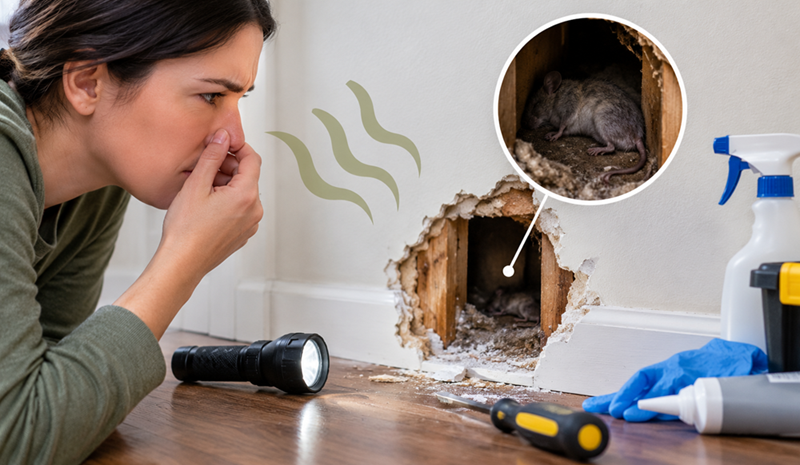
It starts as a faint, sour smell in one room. A day later it’s stronger, and it seems worse when the furnace kicks on. You check the trash, the fridge and the drains, and everything is fine. If that sounds familiar, there’s a good chance a mouse has died inside a wall, ceiling or floor.
This is a common problem in Metro Detroit homes in late fall and winter, when mice move indoors to get out of the cold. Here’s how to confirm the smell, find where it’s coming from, decide whether to open the wall, and stop it from happening again.
Find where the smell is strongest, usually near baseboards, outlets or a ceiling stain. If you can reach the mouse, remove it with gloves and disinfect the spot. If you can’t, ventilate the room and use an odor absorber. One mouse usually stops smelling within about two weeks. Then find how it got in.
A dead rodent smells sour and rotten, a bit like spoiled meat or rotting cabbage. It appears suddenly, gets stronger over a few days and stays in one area. Other household smells behave differently.
| Smell | What it’s like | Where you notice it | Likely cause |
| Dead mouse | Sour, rotten, gets worse over days | One room or one wall, sometimes with flies | A mouse died in a wall, ceiling or floor |
| Mouse urine | Sharp, like ammonia | Cabinets, pantry, under sinks, with droppings nearby | Live mice nesting nearby |
| Musty or earthy | Damp, stale, steady | Basements, bathrooms, around leaks | Mold or mildew |
| Rotten eggs | Sulfur | Near drains, or near the stove or furnace | A dry drain trap, or a gas leak |
| Very strong rot that spreads | Overpowering, lasts weeks | Attic, crawl space, chimney, under a porch | A larger animal such as a squirrel, rat or possum |
Safety first: if the smell is like rotten eggs near a gas appliance, don’t look for a mouse. Leave the house and call your gas company from outside.
If the smell is much stronger than one mouse could cause, a bigger animal may be the source. That’s a job for possum control or wildlife removal, not a mouse trap.
The goal is to narrow the smell down to one section of wall, ceiling or floor before you cut anything. Work slowly and use your nose like a map.
If the smell is strongest when the heat is running, the mouse may be near a duct or the furnace. Avoid spraying air freshener into vents. It doesn’t remove the source, and it mixes with the smell instead of covering it.
A single dead mouse usually smells for a few days to about two weeks. The smell lasts until the body dries out or fully breaks down, and a few things change how long that takes.
| Source | Typical smell time |
| One mouse | A few days to about 2 weeks |
| Several mice in the same area | Longer and stronger than one |
| A rat | Strong for about a week, with some smell for up to a month |
Even after the mouse is removed, a faint smell can linger for up to two weeks while the area airs out.
Only open the wall if you’ve pinpointed the spot and the smell is bad enough to justify a small repair. Otherwise, waiting it out is often the better choice for a single mouse.
| Open the wall when | Wait it out when |
| You’ve narrowed the smell to one small area | You can’t pinpoint where it’s coming from |
| It’s in a bedroom, kitchen or another room you use daily | The smell is mild and already fading |
| Flies keep appearing, or a stain is spreading | The wall is plaster, tile or paneling that’s hard to repair |
| You suspect more than one animal | It’s in a garage or another rarely used space |
If you decide to open it:
Many older Detroit homes have plaster walls rather than drywall. Plaster cracks easily and is harder to patch, so it’s worth getting a professional opinion before you cut.
If you wait it out:
Wet it, bag it twice and disinfect the spot. Never pick up a dead mouse with bare hands, and don’t sweep or vacuum around it, because that can stir germs from droppings and urine into the air. These steps follow CDC cleanup guidance:
Found droppings while you were looking? Our Mice vs Rats guide covers how to tell what left them and how to clean up droppings safely.
A mouse inside your wall got there through a gap, and other mice can use that same gap. Removing one mouse fixes the smell, but it doesn’t fix the problem.
According to Kansas State University Research and Extension, house mice can squeeze through openings slightly larger than ¼ inch. In Metro Detroit homes, the usual entry points are:
How you seal these gaps matters. The same Kansas State guide says steel wool is fine as a temporary plug, but lasting repairs need metal or concrete. Mice can chew through spray foam, plastic, rubber and wood.
Poison is part of why mice end up dying in walls. A mouse that eats store-bought bait doesn’t drop on the spot. It often goes back to its nest inside the wall and dies there. Kansas State advises using bait only where dead mice and odors won’t be a problem, and notes that trapping avoids them.
If you’ve had one dead mouse smell, it’s a good time to look for the gaps before the next mouse finds them. Professional rodent control in Detroit starts with an inspection of the outside and inside of your home, then seals the entry points so the problem doesn’t come back.
The smell is unpleasant, but the bigger concern is the mouse itself. Its body, droppings and nesting material can carry germs, so never handle it with bare hands and follow the safe cleanup steps above.
No. Air fresheners only cover the smell for a short time, and fragrance mixed with decay often smells worse. Odor absorbers like activated charcoal or baking soda help more, but the smell only fully goes when the mouse dries out or is removed.
Yes. Flies are drawn to it, which is why a cluster of flies is often the first clue. Fleas that lived on the mouse can also move off the body.
Warm air speeds up decay, and a running furnace moves air through wall cavities, outlets and vents. Both can carry the smell further into the room.
Not always. If you can find and reach one mouse, you can remove it yourself. Call a professional if you can’t find the source, the smell keeps coming back, or you’re finding more than one dead mouse. Those are signs of an active infestation.
A dead mouse smell fades, but the gap that let the mouse in stays open. If you can’t find the source, the smell keeps coming back, or you’re hearing more scratching in the walls, our technicians can inspect your home and seal the entry points.